UNIverse - Public Research Portal
FEMALE avatar

PD Dr. Anna Marsano

Department of Clinical Research
Profiles & Affiliations

Projects & Collaborations

6 found
Show per page
Project cover

Engineered patches for cardiac repair

Research Project  | 1 Project Members

Background. Revascularization strategies are the current standard clinical procedure for chronic myocardial ischemia which otherwise, if not treated, leads to progressive deterioration of cardiac function and eventually to endstage heart failure. Nevertheless, some patients might benefit from an adjuvant angiogenic therapy supporting the growth of new blood vessels in the ischemic tissue by delivery of pro-angiogenic factors (e.g. vascular endothelial growth factor, VEGF). However, uncontrolled microenvironmental VEGF expression has been shown to cause the growth of aberrant angioma-like vascular tumors. Therefore, we developed a FACS-based technique to rapidly purify transduced adipose tissue-derived stem cells (ASC) that homogeneously express specific and safe VEGF levels from a heterogeneous primary population. Rationale. Controlled VEGF delivery by direct intra-myocardial injection of retrovirally transduced and FACSpurified ASC induced robust growth of normal and stable vessels both in normal and ischemic myocardium, and reliably avoided the growth of aberrant angioma-like structures. In the rat ischemic model only controlled VEGF expression caused a moderate functional improvement. However, survival of the injected progenitors was very limited, in agreement with reported results in the literature. The limited cell engraftment might explain the moderate success of cell injection-based clinical studies. To overcome this limitation we engineered a cardiac 3D patch, generated by coculture of neonatal cardiomyocytes and this time skeletal myoblasts expressing a controlled VEGF level. We observed a robust and normal angiogenesis in the engineered graft, which supported the implanted cell survival and differentiation. Surprisingly, angiogenesis was also greatly improved in the underlying myocardium, where VEGF-expressing cells were not present. Cardiac contractility was also significantly improved in a mouse infarction model. These results show that a patch loaded with genetically engineered progenitors not only lead to a high cell survival upon implantation but also has the potential to deliver controlled VEGF levels to the underlying ischemic myocardium and induce therapeutic vascular growth. We propose in this grant application to develop a cell-based controlled VEGF release system in order to induce a normal and an efficient angiogenesis within the patch itself and in the surrounding cardiac tissue. Specific aims. This proposal covers three specific aims: 1. Obtain the proof of principle that VEGF-expressing ASC can reliably induce normal angiogenesis inside and around the engineered patch (Aim1a) and then determine the minimum amount of engineered cells necessary to ensure the intrinsic angiogenic potential of the patch (Aim1b). 2. Investigate the role of fresh stromal vascular fraction (SVF) derived cells, as source of endothelial progenitors and pericytic origin cells, in the patch vascularization dynamics and in the stabilization of the vascular networks when cocultured with ASC expressing either specific (Aim2a) or heterogeneous (Aim2b) VEGF levels. 3. Test the efficacy and safety of the engineered cell-loaded patch as a controlled VEGF-releasing device to treat cardiac ischemia in rats (Aim3). Experimental design. FACS purified populations of retrovirally-transduced ASC expressing either heterogeneous or specific rat VEGF164 levels will be loaded on a collagen based scaffold by using bioreactor-based culture system. Coculture with SVF will be used to accelerate the in vivo patch vascularization. First, we will use an ectopic rat model to screen out the most promising patch composition to induce normal angiogenesis within the patch and in the surrounding tissue. Then, the intrinsic angiogenic potential of the selected engineered patch will be tested in a cardiac ischemic rat model assessing cardiac functionality. Expected value of the proposed project. The proposed project is expected to provide a basic proof-of-principle to use a cell-based angiogenic factor release system for promoting vascularization in the surrounding tissue. The optimization process will be pursued in order to minimize the quantity of transduced ASC needed and to open up a coculture with SVF. Furthermore, the proposed research will also provide insights of the angiogenic dynamics in vivo and will elucidate the role of SVF in the vascularization process.
Project cover

Engineering of a cell-loaded patch as a controlled VEGF-releasing device

Research Project  | 1 Project Members

Background. Revascularization strategies are the current standard clinical procedure for chronic myocardial ischemia which otherwise, if not treated, leads to progressive deterioration of cardiac function and eventually to endstage heart failure. Nevertheless, some patients might benefit from an adjuvant angiogenic therapy supporting the growth of new blood vessels in the ischemic tissue by delivery of pro-angiogenic factors (e.g. vascular endothelial growth factor, VEGF). However, uncontrolled microenvironmental VEGF expression has been shown to cause the growth of aberrant angioma-like vascular tumors. Therefore, we developed a FACS-based technique to rapidly purify transduced adipose tissue-derived stem cells (ASC) that homogeneously express specific and safe VEGF levels from a heterogeneous primary population. Rationale. Controlled VEGF delivery by direct intra-myocardial injection of retrovirally transduced and FACSpurified ASC induced robust growth of normal and stable vessels both in normal and ischemic myocardium, and reliably avoided the growth of aberrant angioma-like structures. In the rat ischemic model only controlled VEGF expression caused a moderate functional improvement. However, survival of the injected progenitors was very limited, in agreement with reported results in the literature. The limited cell engraftment might explain the moderate success of cell injection-based clinical studies. To overcome this limitation we engineered a cardiac 3D patch, generated by coculture of neonatal cardiomyocytes and this time skeletal myoblasts expressing a controlled VEGF level. We observed a robust and normal angiogenesis in the engineered graft, which supported the implanted cell survival and differentiation. Surprisingly, angiogenesis was also greatly improved in the underlying myocardium, where VEGF-expressing cells were not present. Cardiac contractility was also significantly improved in a mouse infarction model. These results show that a patch loaded with genetically engineered progenitors not only lead to a high cell survival upon implantation but also has the potential to deliver controlled VEGF levels to the underlying ischemic myocardium and induce therapeutic vascular growth. We propose in this grant application to develop a cell-based controlled VEGF release system in order to induce a normal and an efficient angiogenesis within the patch itself and in the surrounding cardiac tissue. Specific aims. This proposal covers three specific aims: 1. Obtain the proof of principle that VEGF-expressing ASC can reliably induce normal angiogenesis inside and around the engineered patch ( Aim1a ) and then determine the minimum amount of engineered cells necessary to ensure the intrinsic angiogenic potential of the patch ( Aim1b ). 2. Investigate the role of fresh stromal vascular fraction (SVF) derived cells, as source of endothelial progenitors and pericytic origin cells, in the patch vascularization dynamics and in the stabilization of the vascular networks when cocultured with ASC expressing either specific ( Aim2a ) or heterogeneous ( Aim2b ) VEGF levels. 3. Test the efficacy and safety of the engineered cell-loaded patch as a controlled VEGF-releasing device to treat cardiac ischemia in rats ( Aim3 ). Experimental design. FACS purified populations of retrovirally-transduced ASC expressing either heterogeneous or specific rat VEGF164 levels will be loaded on a collagen based scaffold by using bioreactor-based culture system. Coculture with SVF will be used to accelerate the in vivo patch vascularization. First, we will use an ectopic rat model to screen out the most promising patch composition to induce normal angiogenesis within the patch and in the surrounding tissue. Then, the intrinsic angiogenic potential of the selected engineered patch will be tested in a cardiac ischemic rat model assessing cardiac functionality. Expected value of the proposed project. The proposed project is expected to provide a basic proof-of-principle to use a cell-based angiogenic factor release system for promoting vascularization in the surrounding tissue. The optimization process will be pursued in order to minimize the quantity of transduced ASC needed and to open up a coculture with SVF. Furthermore, the proposed research will also provide insights of the angiogenic dynamics in vivo and will elucidate the role of SVF in the vascularization process.
Project cover

mLOY: Mosaic Loss of the Y Chromosome and Myocardial Remodeling in Severe Valvular Heart Disease

Research Project  | 5 Project Members

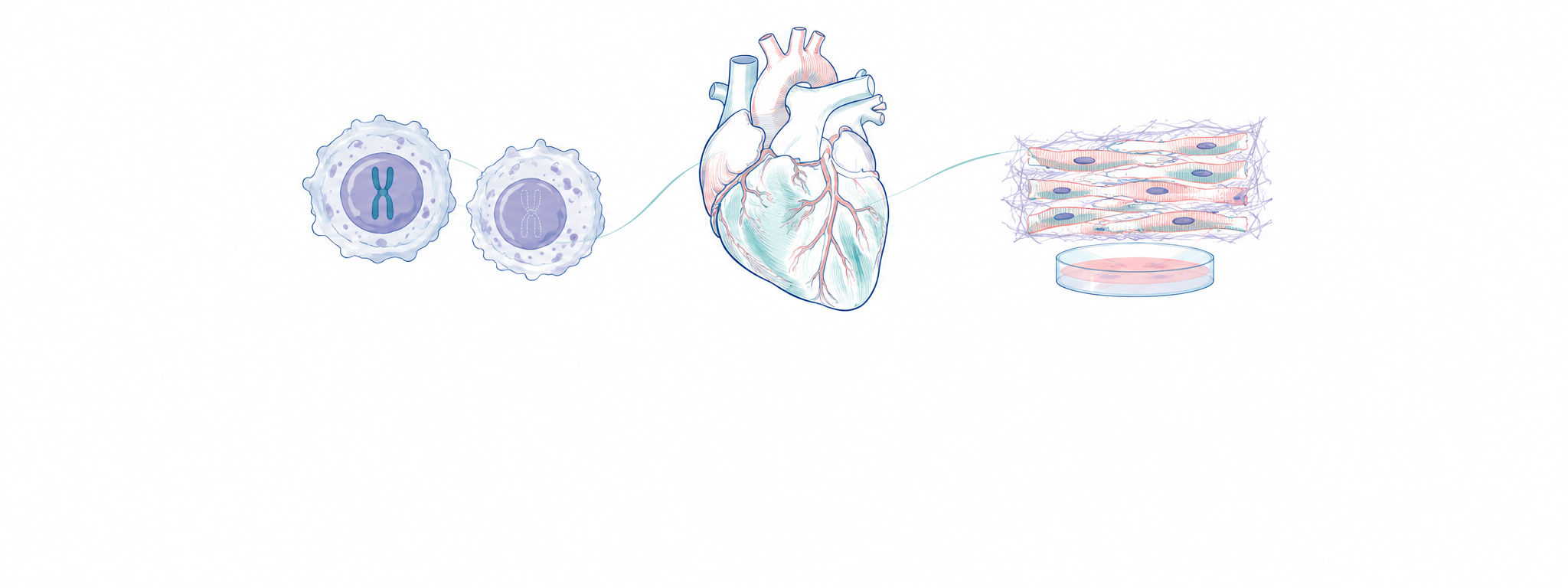
Mosaic loss of the Y chromosome (mLOY) in blood cells is one of the most common acquired genetic changes in aging men. It has been linked to higher cardiovascular risk and mortality and to fibrotic remodeling of the heart, partly through pro-fibrotic immune cells and enhanced TGF-β1 signaling. Whether the Y chromosome is also lost in the heart itself, and how this relates to mLOY in the blood, remains largely unknown.

This translational project studies mLOY in patients with severe valvular heart disease who undergo heart valve surgery. With the patients’ informed consent, blood samples and a small myocardial biopsy are collected during their routine surgery. LOY is then measured in both blood and heart tissue using digital PCR. This lets us link LOY in blood and heart tissue to myocardial remodeling and fibrosis in the same patients.

In parallel, induced pluripotent stem cells (iPSCs) derived from patients are turned into cardiomyocytes and cardiac fibroblasts and studied in 2D and 3D engineered cardiac tissue models. We use these models to find out whether LOY in heart cells comes from the cells’ own susceptibility under stress, such as ischemia or pro-fibrotic signaling, or from signals sent by LOY-affected immune cells. We also test whether blocking TGF-β1 can counteract fibrotic remodeling.

The project is a collaboration between three groups: the Department of Cardiac Surgery at the University Hospital Basel (Prof. Dr. med. Hassina Baraki), the Cardiac Surgery and Engineering Group of PD Dr. Anna Marsano (Department of Biomedicine, University of Basel), and the University Medical Center Göttingen (Prof. Dr. med. Elisabeth Zeisberg).