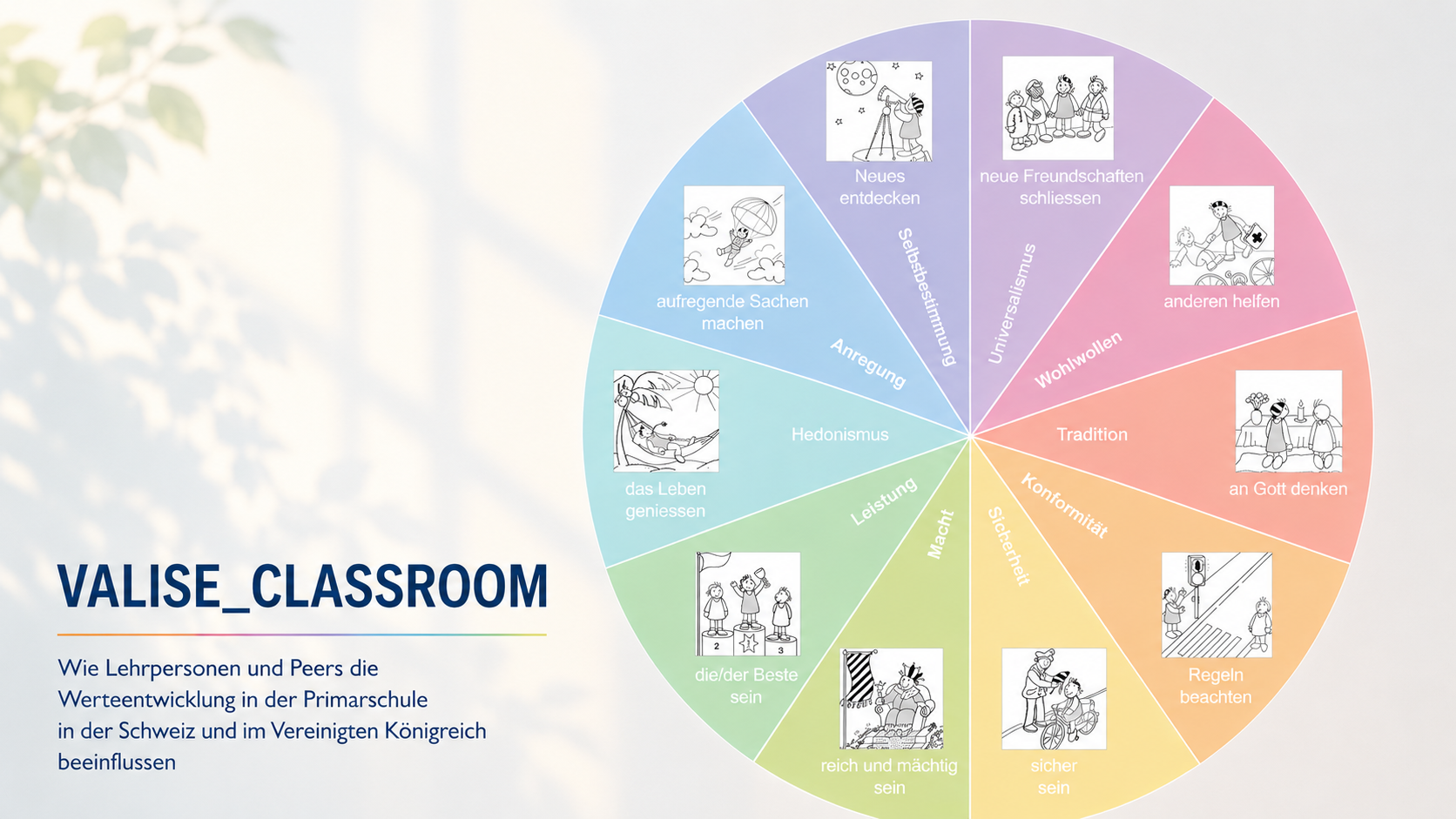
The Agora project, titled “VALUES in Action: Empowering Swiss Teachers Through Evidence-Based Values Education,” builds on findings from the SNSF-funded research project VALISE (2020-2024). The VALISE research project explored the development of values among primary school children in Switzerland and the United Kingdom. The AGORA project “VALUES in Action” aims to communicate the most important findings from research on value development in primary schools to practitioners, and in doing so promote values education in Swiss primary schools. Led by the Institute for Educational Sciences at the University of Basel, the project addresses a crucial gap between abstract research on values and their practical application in classrooms. It recognizes values as guiding principles, which relate to perceptions, attitudes, and behaviors.
Despite international recognition of the importance of values education, many teachers face challenges in implementing it effectively. The project aims to empower educators by developing an interactive, research-driven digital platform with three key objectives:
- Self-Reflection: Tools that help teachers examine their values and how they relate to classroom interactions.
- Knowledge Enhancement: Comprehensive resources, including expert videos, to deepen understanding of values and their role in education.
- Practical Solutions: A toolkit of age-appropriate activities, which encourage meaningful dialogue between students and teachers.
A distinctive feature of the project is its collaborative approach, involving primary school teachers from the outset to ensure the platform meets their needs. The co-creation process fosters practical relevance and usability.
The project is supported by an interdisciplinary team, including value education specialists and communication experts. Partners such as éducation21 help disseminate the platform and align it with national educational goals. The platform also incorporates inclusive practices to promote diversity and equity, equipping teachers with tools to foster respectful, empathetic, and culturally competent learning environments.
The project aims to make a meaningful impact by boosting teachers' skills, fostering greater pupil engagement with democratic principles, and building stronger, more cohesive school communities. By integrating values education into Swiss primary schools, it seeks to nurture future generations to be empathetic, inclusive, and socially responsible.