UNIverse - Public Research Portal
FEMALEavatar

Dr. med. Pascale Grzonka

Department of Clinical Research
Profiles & Affiliations

Intensivmedizin, speziell Neurointensivmedizin

Selected Publications

Grzonka, Pascale, Mosimann, Tamina, Berger, Sebastian, Amacher, Simon A., Baumann, Sira M., Gebhard, Caroline E., De Marchis, Gian Marco, Dittrich, Tolga D., & Sutter, Raoul. (2025). Unveiling the clinical spectrum of herpes simplex virus CNS infections in adults: a systematic review. Systematic Reviews, 14. https://doi.org/10.1186/s13643-025-02797-0

URLs
URLs

Grzonka, Pascale, Baumann, Sira M., Tisljar, Kai, Hunziker, Sabina, Marsch, Stephan, & Sutter, Raoul. (2023). Procedures of brain death diagnosis and organ explantation in a tertiary medical centre – a retrospective eight-year cohort study [Journal-article]. Swiss Medical Weekly, 153(1), 40029. https://doi.org/10.57187/smw.2023.40029

Grzonka, Pascale, Scholz, Marleen C., De Marchis, Gian Marco, Tisljar, Kai, Rüegg, Stephan, Marsch, Stephan, Fladt, Joachim, & Sutter, Raoul. (2020). Acute Hemorrhagic Leukoencephalitis: A Case and Systematic Review of the Literature [Journal-article]. Frontiers in Neurology, 11. https://doi.org/10.3389/fneur.2020.00899

Selected Projects & Collaborations

Project cover

Anisocoria in the ICU (AICU study): Diagnostic Implications and Clinical Outcomes

Research Project  | 3 Project Members

Background: Assessment of the pupils regarding symmetry and reactivity to light are important parts of the neurological evaluation of critically ill patients treated in intensive care units. Thereby, anisocoria can be found in up to 60% of patients with acute neurologic injuries(2). Furthermore, anisocoria or pupillary areflexia can be signs of increasing intracranial hypertension with brain herniation, ischemia in traumatic brain injury, cerebrovascular accidents, intoxication with psychotropic and neurotropic drugs including anticholinergic, opioids, and cannabinoids. While anisocoria or impaired pupillary reactivity may result from such devastating cerebral injuries, they can also be caused by more benign and potentially reversible scenarios, such as pharmacological effects (e.g. agents such as ipatroprium bromide) or as part of the Horner’s syndrome following jugular central venous cannulation. Despite these well-known underlying pathomechanisms of pupillary anomalias, data on the prevalence and associated clinical consequences of anisocoria in non-selected general ICU populations is scarce. Due to the lack of data on the prognostic implications of anisocoria or changes in pupillary reactivity for non-neurological ICU patients, the new onset of any pupillary abnormality necessitates a rapid and thorough evaluation usually including clinical neurological examination and the performance of neuroimaging, such as a cerebral computed tomography (CT) or magnetic resonance imaging (MRI). Considering the the variety of more benign and reversible causes of pupillary abnormalities, alongside the potential for missed underlying pathomechanisms with severe clinical implications, it is highly probable that a significant number of unremarkable CT or MRI scans are conducted to investigate acute pupillary abnormalities. This practice may expose patients to unnecessary risks and contribute to increased healthcare costs. While quantitative pupillometry with dynamic pupil assessments after light has shown some promise to distinguish between clinically relevant anisocoria and benign variations, further validation is still lacking. Unfortunately, studies elucidating to what extent a cerebral CT or MRI detects clinically relevant findings in specific patient groups with particular clinical contexts, and in which clinical scenarios CTs are likely to provide no clinical relevance beyond exposing the patient to radiation are still pending.


Objectives: This retrospective single-center cohort study has four primary objectives. 

-   First, it aims to determine the prevalence of acute "new onset" pupillary abnormalities (anisocoria and/or impaired light-reactive pupillary response) in adult ICU patients. 

-   Second, it seeks to assess the clinical impact of these abnormalities, particularly in terms of the frequency of diagnostic tests ordered, such as neuroimaging (i.e., head CT or MRI scans, and ophthalmologic and neurologic consultations. 

-   Third, the study aims to identify specific clinical contexts in which significant pathological findings lead to treatment modifications, as well as those scenarios where no clinically relevant findings are detected.

-   Finally, it evaluates the prognostic implications of these pupillary abnormalities on patient outcomes.

Project cover

Determining ICU Staff's Conceptions, Opinions, Views, Experiences and Reflection of Brain Death and Organ Donation (DISCOVER)

Research Project  | 4 Project Members

Background: Brain death is the irreversible loss of brain function necessary to sustain life. Its diagnosis is based on the absence of brainstem reflexes, unresponsiveness to endo- or exogenous stimuli, apnea, and the exclusion of factors confounding the clinical presentation(4). While other organ functions may be preserved, the identification of brain death raises the question of whether viable organs can and should be transplanted to save the lives of critically ill patients in need of organ support.


With advancements in critical care techniques enabling the maintenance of organ function beyond brain death, as well as the intricate legal and regulatory frameworks surrounding organ donation, healthcare professionals in intensive care units are increasingly faced with complex clinical scenarios, considerations, and challenges related to the concept and diagnosis of brain death and ethical and legal aspects associated with organ donation. Studies investigating the individual conceptual understanding of brain death and organ donation of health care professionals on Intensive Care Units (ICUs) as well as their experiences and opinions related to these topics, are scarce(5-8).


Objectives: The study aims to gather information regarding the individual perceptions, opinions, beliefs, and conceptual understanding of healthcare professionals working in the intensive care units at the University Hospital Basel and to determine associations of individual beliefs, personal, educational, and professional experiences with individual perceptions, opinions, and conceptual understanding regarding brain death and organ donation. 

To achieve the study objectives, we will employ a questionnaire-based survey administered to the consenting/participating nurses and physicians. The questionnaire will address various aspects related to personal background, religious affiliation, beliefs about life after death, the conceptual understanding of brain death and organ donation, as well as experiences and opinions related to these topics.

Participating in this study will create no additional risk or burden for patients and is therefore classified under category A according to HRO Art. 7.(1)


The primary objective of this study is to gather insights into the individual perceptions, opinions, beliefs, and conceptual understanding regarding brain death and organ donation of healthcare professionals working in the ICU at the University Hospital Basel in Switzerland. 

The following hypotheses will be tested: Individual perceptions, opinions, beliefs, and conceptual understanding regarding brain death and organ donation vary between the different professions and in dependence of specific aspects regarding personal, educational and professional experiences.


The primary endpoints of this study will be information on individual perceptions, opinions, beliefs, and conceptual understanding of healthcare professionals in the ICU regarding brain death and organ donation and the identification ofinterprofessional variations.


The secondary endpoints will be associations of specific demographics, beliefs, personal, educational, social and professional experiences with individual perceptions, opinions, and conceptual understanding regarding brain death and organ donation.


References

1.         Council TSF. Ordinance on Human Research with the Exception of Clinical Trials (HRO)2013.

2.         Council TSF. Ordinance on Clinical Trials in Human Research (HRA)2013.

3.         World Medical A. World Medical Association Declaration of Helsinki: ethical principles for medical research involving human subjects. Jama. 2013;310(20):2191-4.

4.         Wijdicks EF. The diagnosis of brain death. N Engl J Med. 2001;344(16):1215-21.

5.         Ferhatoglu SY, Ferhatoglu MF, Gurkan A. Approach of the Clinicians Practicing in Intensive Care Units to Brain Death Diagnosis and Training Expectations in Turkey: A Web-Based Survey. Transplant Proc. 2020;52(10):2916-22.

6.         Al-Mousawi M, Abdul-Razzak M, Samhan M. Attitude of ICU staff in Kuwait regarding organ donation and brain death. Transplant Proc. 2001;33(5):2634-5.

7.         Ong JS, James Foong W, Oo WL, Vallapil MK, Hossain MM, Hossain H, et al. Does knowledge and attitude of healthcare professionals working in critical care areas affect their willingness to offer the option of organ donation? results of a tertiary hospital survey. Med J Malaysia. 2022;77(3):347-56.

8.         Camut S, Baumann A, Dubois V, Ducrocq X, Audibert G. Non-therapeutic intensive care for organ donation: A healthcare professionals' opinion survey. Nurs Ethics. 2016;23(2):191-202.

Project cover

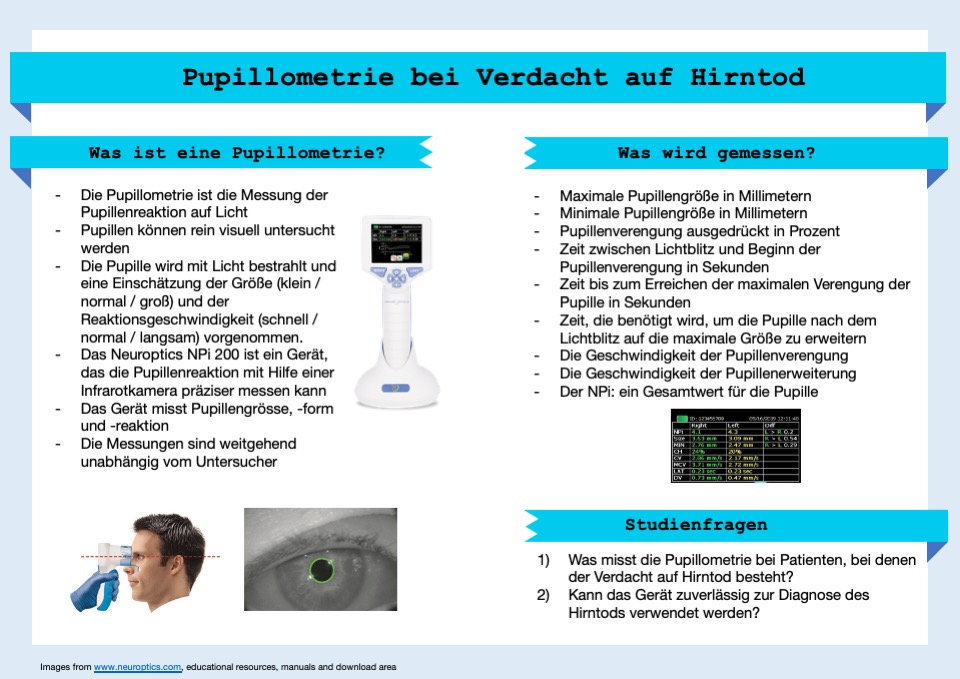
Pupillometric Evaluation in Patients Declared Brain Dead (INSPECT) - a Prospective Quality Control Study

Research Project  | 4 Project Members

Objectives: The aim of the study is to verify the reliability of the current purely clinical examination of the pupils (without the support of a pupillometer) in the context of clinically suspected brain death, compared to the results of a non-invasive, automated, and highly precise monocular pupillometric examination.


Methods: This prospective quality control study will evaluate the reliability of the clinical exam regarding pupils' reaction to light (as performed by two board certified physicians in Neurology and/or Intensive Care Medicine) as recommended by the SAMW guidelines for brain death diagnosis (SAMW-guidelines) when compared to the results of a noninvasive automated and highly-precise pupillometry in adult patients with clinically suspected brain death. Automated pupillometric measurements will be performed by the PI (RS), or the co-investigator (Dr. Pascale Grzonka) using the NeurOptics® NPi®-200 pupillometer system immediately before and after the standardized diagnostic workup for suspected brain death. In addition, demographics, clinical characteristics , treatment and laboratory data from the patients examined will be anonymously collected.