Background: According to the International Labor Organization, workplace violence is defined as any action, incident or behavior that departs from reasonable conduct in which a person is assaulted, threatened, harmed, injured in the course of, or as a direct result of his or her work (4). Healthcare workers are at the highest risk of experiencing workplace violence of any occupational group (5). Workplace violence is a common and widespread occurrence and is of growing concern in the health care industry because of the additional burden it places on the health care system and staff (6-8). Violence can occur in a wide variety, ranging from verbal or physical offenses to sexual harassment (9, 10). Workplace violence has been studied primarily in psychiatric and emergency departments but is believed to be understudied and underreported in other settings such as the intensive care unit (8). Very little is known about its prevalence and potential risk factors, resulting in a lack of awareness and established preventative and intervention strategies (11, 12).
Workplace violence can be an additional burden on staff in addition to long working hours, shift work and understaffing. It has been shown to be associated with an increased likelihood of poor mental and general health and risk of burnout (13). This may further exacerbate the ongoing shortage of ICU professionals as violence leads healthcare workers to leave their field due to the adverse working conditions (14, 15). Importantly, workplace violence might lead to lower levels of nurse patient safety competence (16). Since the problem is not limited to the ICU but is common to all of healthcare, the knowledge gained from studying this issue can most likely be transferred to other areas of healthcare to improve the work environment and safety of both staff members and patients.
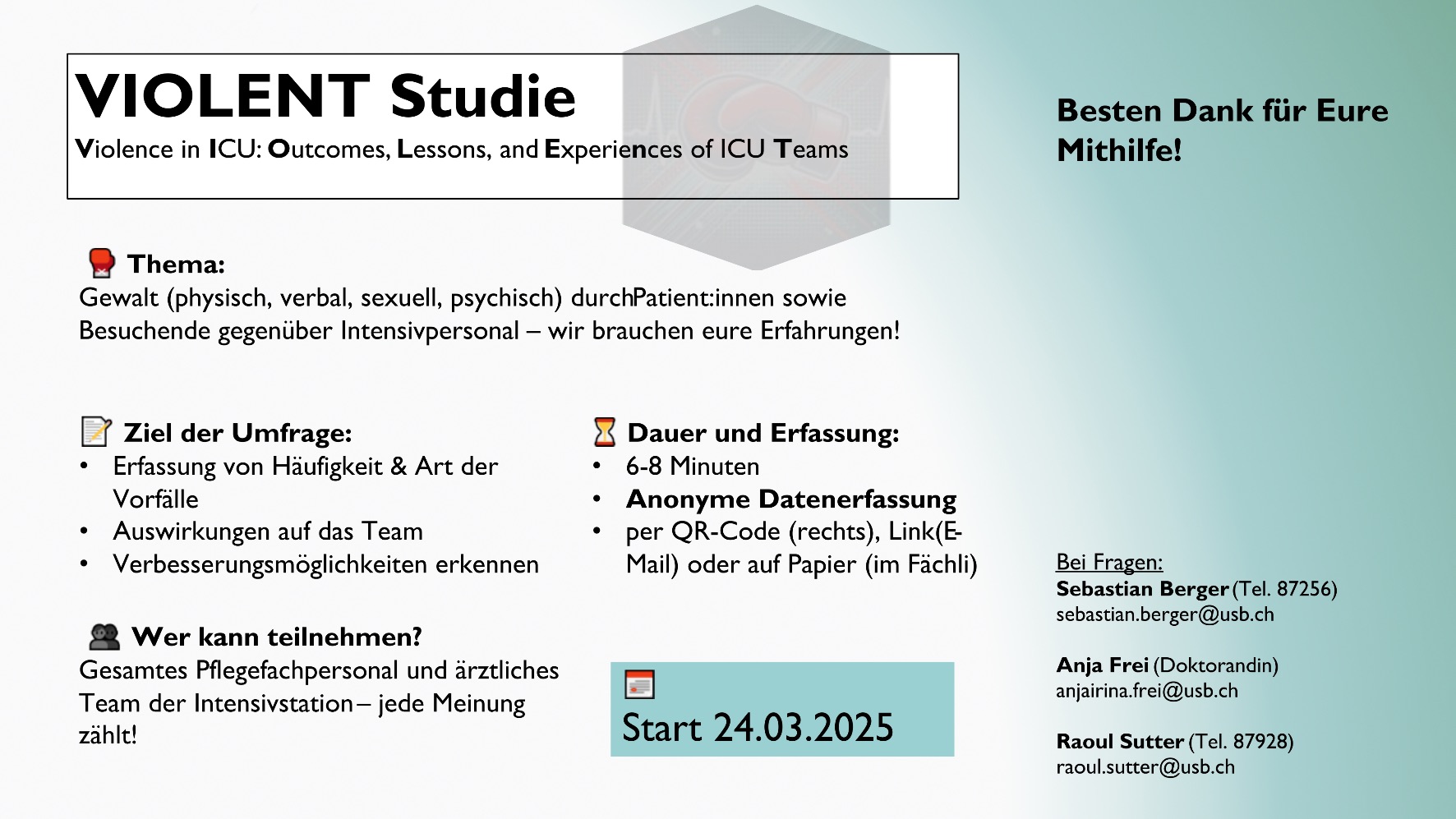
This study aims to investigate the perceptions, experiences, and responses of healthcare professionals working in the intensive care units in Switzerland concerning patient violence. It will examine the frequency, context, and underlying factors contributing to violent incidents, as well as the measures taken by staff to manage these situations. Additionally, the study will explore how personal, educational, and professional backgrounds influence healthcare professionals' understanding and handling of patient violence. The research will also assess the impact of such incidents on staff well-being, job satisfaction, and patient care, with the goal of identifying effective measures for prevention and intervention.
To achieve the objectives of this study, we will administer a online questionnaire-based multi-center survey in REDcap and a paper questionnaire (participants may choose their preferred way of answering) to consenting nurses and physicians working in the ICU. The questionnaire will cover various aspects, including personal background (such as education and professional role), the frequency and nature of past incidents of workplace violence, the responses and measures taken following these incidents, any psychological or professional consequences experienced, and current strategies for preventing violence. Additionally, the survey will seek participants' suggestions for improving safety and creating a more supportive work environment in the ICU. Participating in this study will create no additional risk or burden for patients and is therefore classified under category A according to HRO Art. 7.(1)
Objectives: To gather insights into the experiences, characteristics, and attitudes of healthcare professionals working in the ICU at the University Hospital Basel in Switzerland, regarding workplace violence from patients. This study will focus on incidents where patients or relatives exhibited violent behaviour towards ICU staff members and aims to explore factors such as the context of these incidents, their impact, and the aftermath of it.
The following hypotheses will be tested: Healthcare professionals working in the ICU will perceive workplace violence from patients or relatives in various ways, with differing views on its frequency, manifestations, context, and impact. The study will explore how often such incidents occur, the characteristics of the incidents, how they are reported (if at all), and the aftermath of these incidents, including any personal or professional consequences.
Methods: The primary endpoints of this study will be to compile information on healthcare professionals' perceptions, experiences, and attitudes regarding workplace violence from patients or relatives in the ICU, including the frequency, context, impact, and reporting of such incidents.
The secondary endpoints will explore associations between specific demographics, personal, educational, and professional backgrounds, as well as prior experiences, with healthcare professionals' perceptions of and responses to workplace violence, including factors influencing reporting and the aftermath of violent incidents.
We therefore will employ a multi-center survey design using a questionnaire-based approach. The questionnaire will be distributed to consenting nurses and physicians working in the ICU at the participating hospitals (planned inclusion at University Hospital Basel, Kantonsspital Aarau, Inselspital Bern, Spitalzentrum Biel, Universitätsspital Zürich and others). Based on the results and feasibility of our initial survey, we aim to broaden the scope to include additional Swiss intensive care units, transforming the study into a multi-center survey. This approach would allow for a more comprehensive analysis of the issue, capturing diverse perspectives and increasing the generalizability of the findings. Consent is given by participants by filling out the questionnaire, as the participants will be prompted about the further use of the data they enter during the questionnaire.
References
1. Council TSF. Ordinance on Human Research with the Exception of Clinical Trials (HRO)2013.
2. Council TSF. Ordinance on Clinical Trials in Human Research (HRA)2013.
3. World Medical A. World Medical Association Declaration of Helsinki: ethical principles for medical research involving human subjects. Jama. 2013;310(20):2191-4.
4. ILO. Code of practice on workplace violence in services sectors and measures to combat this phenomenon. International Labour Review. 2003;143(October):20.
5. U.S. Bureau of Labor Statistics. Workplace Violence in healthcare. 2018.
6. Liu J, Gan Y, Jiang H, Li L, Dwyer R, Lu K, et al. Prevalence of workplace violence against healthcare workers: a systematic review and meta-analysis. Occup Environ Med. 2019;76(12):927-37.
7. Vento S, Cainelli F, Vallone A. Violence Against Healthcare Workers: A Worldwide Phenomenon With Serious Consequences. Front Public Health. 2020;8:570459.
8. Berger S, Grzonka P, Frei A, Hunziker S, Baumann S, Amacher S, et al. Violence against healthcare professionals in intensive care units: a systematic review and meta-analysis of frequency, risk factors, interventions, and preventive measures. Critical Care. 2024.
9. Spector PE, Zhou ZE, Che XX. Nurse exposure to physical and nonphysical violence, bullying, and sexual harassment: a quantitative review. Int J Nurs Stud. 2014;51(1):72-84.
10. Shafran-Tikva S, Zelker R, Stern Z, Chinitz D. Workplace violence in a tertiary care Israeli hospital - a systematic analysis of the types of violence, the perpetrators and hospital departments. Israel Journal of Health Policy Research. 2017;6(1):43.
11. Hahn S, Müller M, Hantikainen V, Kok G, Dassen T, Halfens RJ. Risk factors associated with patient and visitor violence in general hospitals: results of a multiple regression analysis. Int J Nurs Stud. 2013;50(3):374-85.
12. Slack RJ, French C, McGain F, Bates S, Gao A, Knowles S, et al. Violence in intensive care: a point prevalence study. Crit Care Resusc. 2022;24(3):272-9.
13. Stahl-Gugger A, Hämmig O. Prevalence and health correlates of workplace violence and discrimination against hospital employees - a cross-sectional study in German-speaking Switzerland. BMC Health Serv Res. 2022;22(1):291.
14. Poon Y-SR, Lin YP, Griffiths P, Yong KK, Seah B, Liaw SY. A global overview of healthcare workers’ turnover intention amid COVID-19 pandemic: a systematic review with future directions. Human Resources for Health. 2022;20(1):70.
15. LeClaire M, Poplau S, Linzer M, Brown R, Sinsky C. Compromised Integrity, Burnout, and Intent to Leave the Job in Critical Care Nurses and Physicians. Critical Care Explorations. 2022;4(2):e0629.
16. Lanctôt N, Guay S. The aftermath of workplace violence among healthcare workers: A systematic literature review of the consequences. Aggression and violent behavior. 2014;19(5):492-501.