English:
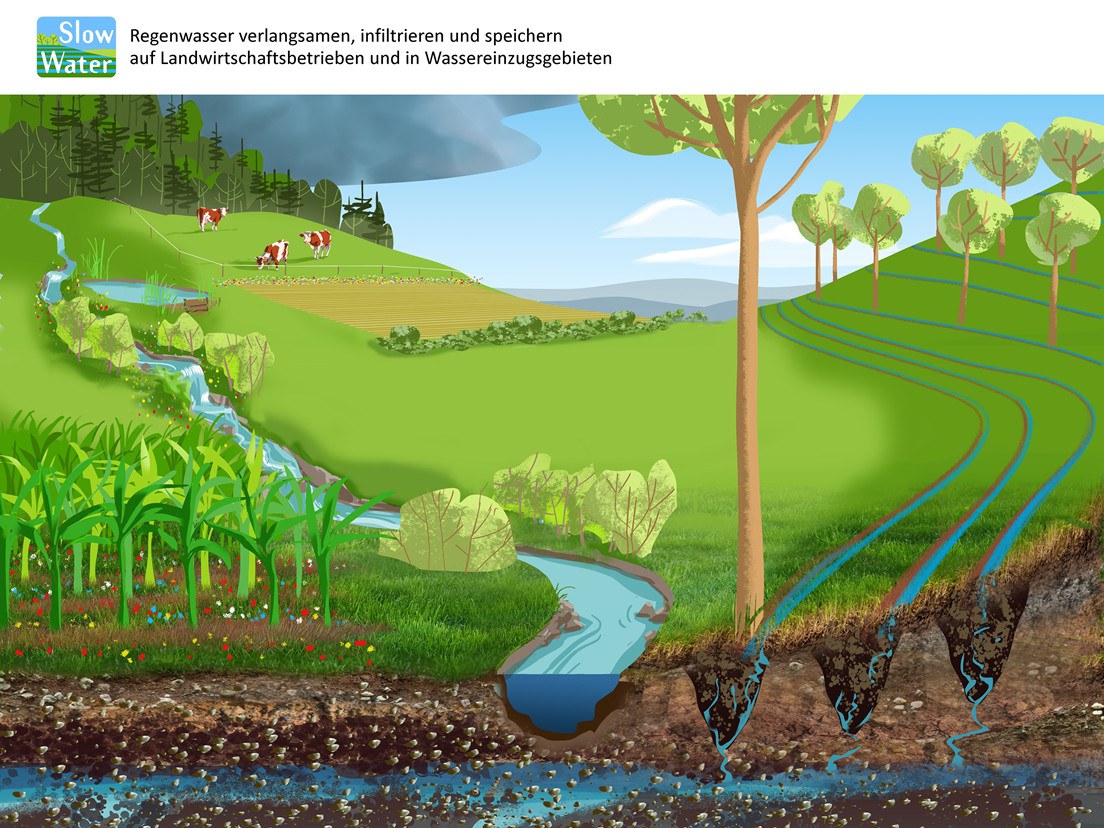
Mountainous countries like Switzerland are overproportionally affected by climate change, with temperature rise and increasing weather extremes such as heat waves, droughts, and torrential rainfalls already being more pronounced than elsewhere. Under these circumstances, water supply is becoming a major challenge for agriculture, be it for crop production or animal husbandry. In addition, water in mountain communities becomes increasingly scarce during summer months. This is where the Swiss Federal Office of Agriculture FOAG-funded "Slow Water" project comes in: In 3 hydrologically and geographically distinct pilot regions of Switzerland, farm-specific, catchment-related water retention strategies are developed and implemented based on a catalogue of 15+ different nature-based water retention measures, through a co-creation process involving municipalities, farmers, authorities and scientists. The integral impacts of the nature-based water retention measures on increasing water availability and decreasing streamflow extremes are assessed through a combination of hydrological monitoring, drone-based assessments and numerical modelling. The Slow Water project consortium consists of the Hydrogeology research group of University of Basel and Eawag, the Global Land Use and Change group of University of Basel, the agricultural offices of the Cantons of Basel-Landschaft (Ebenrain) and Luzern (LAWA), Seecon GmbH, Agridea, municipalities and farming associations.
Deutsch:
Alpenländer wie die Schweiz sind überproportional vom Klimawandel betroffen, und der Temperaturanstieg und zunehmende Wetterextreme wie Hitzewellen, Dürren und Starkregenereignisse sind hier bereits jetzt ausgeprägter als anderswo. Unter diesen Umständen wird die Wasserversorgung zu einer grossen Herausforderung, insbesondere auch für die Landwirtschaft, sei es für den Pflanzenbau oder die Tierhaltung. Darüber hinaus wird Wasser in Gemeinden ohne Anschluss an grössere Grundwasservorkommen, Flüsse oder Seen, was typisch ist für Berggemeinden, während der Sommermonate zunehmend knapp. Hier setzt das vom Bundesamt für Landwirtschaft BLW finanzierte Ressourcenprojekt «Slow Water» an: In drei hydrologisch und geografisch unterschiedlichen Pilotregionen der Schweiz werden auf der Grundlage eines Katalogs von mehr als 15 verschiedenen kleinskaligen, naturbasierten Wasserrückhaltemassnahmen in einem ko-kreativen Prozess unter Einbezug von Gemeinden, LandwirtInnen, Behörden und WissenschaftlerInnen betriebs- und einzugsgebietsspezifische Wasserrückhaltestrategien entwickelt und Massnahmen umgesetzt. Die integralen Auswirkungen der naturbasierten Wasserrückhaltemassnahmen auf die Erhöhung der Wasserverfügbarkeit und die Verringerung von Extremabflüssen werden durch eine Kombination aus hydrologischer Überwachung, drohnenbasierten Analysen und numerischer Modellierung bewertet. Das Konsortium des «Slow Water»-Projekts besteht aus der Forschungsgruppe Hydrogeologie der Universität Basel und der Eawag, der Forschungsgruppe Globale und regionale Landnutzungsänderungen der Universität Basel, den landiwrtschaftsämtern der Kantone Basel-Landschaft (Ebenrain) und Luzern (LAWA), Seecon GmbH, Agridea, Gemeinden, und Landwirtschaftsverbänden.