UNIverse - Public Research Portal

Functional Biomechanics

Projects & Collaborations

19 found
Show per page
Project cover

InnoTreat: Towards Personalized Treatment Decisions with Digital Twins

Research Project  | 4 Project Members

Das Projekt InnoTreat: Towards Personalized Treatment Decisions with Digital Twins zielt darauf ab, die klinische Diagnose und Behandlungsentscheidungen bei Schulterpathologien zu präzisieren. Durch die Integration von patientenspezifischer Anatomie in biomechanische Simulationen soll das Projekt Einblick in die zugrunde liegenden Mechanismen der Schulterpathologie geben und dadurch Rehabilitationsprogramme zielgerichteter abstimmen. Das Projekt konzentriert sich auf Rupturen der Rotatorenmanschette, von denen ein erheblicher Teil der Bevölkerung betroffen ist, und befasst sich mit den Grenzen der derzeitigen Behandlungsmöglichkeiten durch die Entwicklung einer digitalen Zwillingsanwendung, die patientenspezifische Diagnosen und veränderte Biomechanik visualisiert. Die institutionenübergreifende Zusammenarbeit nutzt die Expertise in der Bildgebung (Universität Zürich), der Biomechanik (ZHAW) und der klinischen Praxis (Universitätsspital Basel) im Rahmen einer iterativen Forschungszusammenarbeit.

Project cover

A randomized controlled trial on the effectiveness of remote app assisted physiotherapy in patients with non-specific low back pain

Research Project  | 4 Project Members

In Switzerland, 1.5 million people suffer from low back pain (LBP), which is often the cause of disability [1]. Non-specific LBP is a major cause of high healthcare costs in developed countries and often leads to early retirement [2]. The development of musculoskeletal assessment through remote app-assisted therapeutic home training may be useful for individuals with non-specific LBP, providing initial support for its implementation in primary care in the patient's home [3]. App-supported therapeutic solutions allow healthcare professionals to prescribe and monitor rehabilitation programs remotely. These innovative solutions have the potential to reduce healthcare costs and provide clinical outcomes comparable or even better than conventional physiotherapy (PT), especially for patients in remote areas [4]. Akina Cloud, a digital health application developed by an ETH spin-off to support therapeutic exercises in people with musculoskeletal disorders, is the first remote app-assisted therapeutic home training solution available in Switzerland. It provides patients with exercise and educational content and facilitates communication between patients and therapists via the application. The aim of this study is to show the efficacy of the remote app-assisted physiotherapy through Akina Cloud in patients with non-specific LBP. 

Project cover

CADENCE - Clinical Biomechanics and Ergonomics Engineering Equipment

Research Project  | 5 Project Members

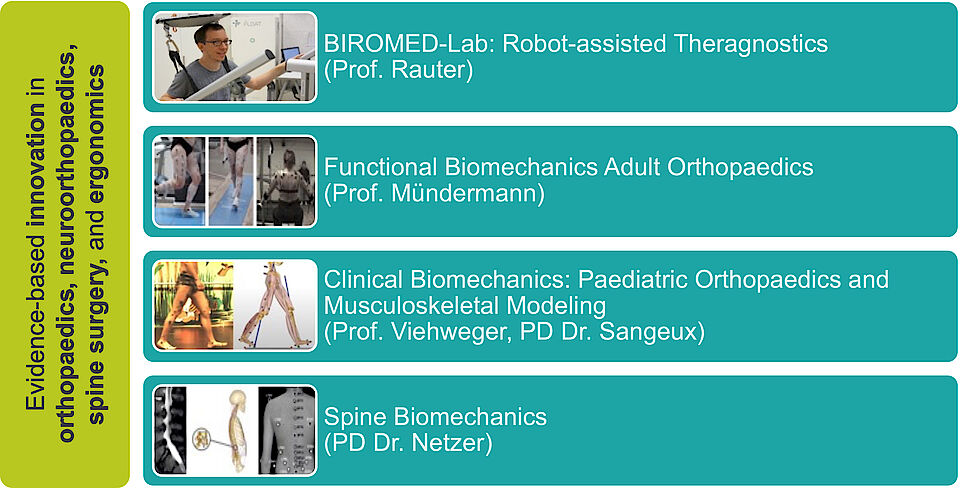
In December 2021, the new research unit ‘Clinical Biomechanics and Ergonomics Engineering’ (CADENCE) was formed at Department of Biomedical Engineering (DBE) at the University of Basel (https://dbe.unibas.ch/en/research/biomechanics-and-biomaterials/cadence/) comprising the research groups ‘Functional Biomechanics’, ‘Robot-assisted Theragnostics’, ‘Paediatric Orthopaedic Biomechanics and Musculoskeletal Modelling’, and ‘Spine Biomechanics’. CADENCE facilitates innovative and groundbreaking interdisciplinary research in biomedical engineering and biomechanics and serves as teaching facility for courses on diagnostic and therapeutic technologies within the new Master of Science program and the PhD programs at the DBE. The R`Equip grant supports CADENCE in the purchase of a range of state-of-the-art sensor technologies and the world’s first 3D gait rehabilitation robot ‘The FLOAT’. This investment is critical for the unique and internationally leading role of the research groups in the research and innovation ecosystem in the Basel region.

Project cover

HamRepair: Clinical and functional outcomes at least 2 years after hamstring muscle repair – a pilot study

Research Project  | 5 Project Members

Several studies from the past 10 years have shown a significant subjective benefit after a surgical treatment in comparison to a conservative treatment of a proximal hamstring rupture.4-7 There is also a strong evidence of about 10% decrease in muscle strength in comparison to the non operated site4,13. Similar muscle strength between the operated and contralateral side was observed up to 10 years after repair.14 However, to the best of our knowledge there is a lack of evidence in possible development of biomechanical and functional limb asymmetries including muscle activity caused by these postoperative muscular imbalances. Our project will therefore concentrate on the biomechanics of gait and daily activity tasks and investigate differences between the operated and contralateral limb. Primarily we will quantify potential muscular deficits between limbs and compare these to the findings of the gait pattern. If proven right and limping does occur, it can, on the long run, cause earlier onset of skeletal degeneration and osteoarthritis.8-10 As the mean age of the patients examined in the studies with hamstring rupture is usually about 40 to 45 years6 and the average life expectancy is above 80 years11, potential muscular deficits may manifest as pathological gait that may predispose these patients to premature and potentially more severe degenerative processes. For instance, it is possible that the risk of hip osteoarthritis and/or lower back or iliosacral joint osteoarthritis is higher in patients after a hamstring rupture. Therefore, improving the understanding of biomechanical and functional outcome after hamstring repair is critical, and potential deficits may be prevented with additional physiotherapy addressing muscular imbalances. In the proposed pilot study, we will compile outcome data on the outcome of a new, intraoperative lateral positioning of the anchors on the tuber ischiadicum, as was used in all of our patients, in comparison to regular anatomical anchoring direct on top of the tuber ischiadicum.12 Based on our clinical experience many patients describe a local discomfort in seated position with traditional anchor positioning, and a lateral positioning could potentially prevent this complaint as the lateral area of os ischi is not exposed to the pressure when seated. With this pilot study we will not only provide new insights into the postoperative function of the hamstrings with corresponding gait pattern for the current patients, but also possibly prevent the discomfort while sitting by changing anchor placement in future patients. Further, the data obtained in this study will facilitate proper sample size calculations for future clinical trials.

Project cover

Klinische und funktionelle Resultate 2 Jahre nach VKB Naht mit Internal Brace Augmentation im Vergleich zur VKB Rekonstruktion unter Berücksichtigung sozioökonomischer Aspekte und Rückkehr zur Arbeitsfähigkeit

Research Project  | 4 Project Members

Der Stellenwert des Erhaltes des vorderen Kreuzbandes nach VKB Ruptur wird kontrovers diskutiert - insbesondere spielt dabei das Internal Bracing, also die Ligament Augmentation zusätzlich zur Naht, eine zentrale Rolle. In unserer Klinik haben wir mittlerweile über 60 Patienten mit dieser Technik operiert mit sehr guten klinischen Resultaten. Allerdings bleibt die Literatur bis dato objektive funktionelle und biomechanische Resultate dieses Verfahrens schuldig, die jedoch auch prognostisch, v.a. im Hinblick auf die Entstehung einer sekundären Kniegelenksarthrose, höchst relevant sind. Basierend auf den sehr erfreulichen klinischen Resultaten ist das Ziel der vorliegenden Studie daher, erstmalig eine umfassende objektive und quantitative klinische und funktionelle Untersuchung bei Patienten nach VKB Naht in direktem Vergleich mit der Goldstandard Technik, der VKB Rekonstruktion, und einem Kniegesunden Kontrollkollektiv durchzuführen. Die hier durchgeführten Tests werden somit wichtige neue Erkenntnisse liefern über den Funktionszustand sowie die Mechanik der Kniegelenke nach Internal Bracing und ob diese Patienten im direkten Vergleich zur Rekonstruktion ein geringeres Muskelkraftdefizit und eine verbesserte Gangfunktion aufgrund der erhaltenen Anatomie des genähten VKBs aufweisen, die als protektive Faktoren der Arthroseentstehung anzusehen sind. Die Studie bildet somit die Grundlage für weitere Untersuchungen zur Optimierung der Behandlung künftiger Patienten (inklusive einer optimierten Patientenselektion) und wird wichtige Erkenntnisse für die Optimierung der Rehabilitation nach primärer VKB Naht sowie nach Rekonstruktion liefern mit Relevanz im Kontext der Gonarthrose.

Project cover

Clinical and functional outcomes 2 years after ACL repair and InternalBraceTM ligament augmentation in comparison with ACL reconstruction and healthy controls

PhD Project  | 5 Project Members

For patients with proximal anterior cruciate ligament (ACL) tears, primary ACL repair

with additional suture tape augmentation (ACL-IB, InternalBraceTM) has been introduced as an

alternative procedure to ACL reconstruction (ACL-R). The advantages of ACL repair over

ACL-R include preservation of the native ligament and lack of tendon harvesting. However,

evidence on the outcome of ACL-IB has only started to emerge. First studies on ACL-IB after

proximal ACL tears have reported promising results in patient-reported outcome measures and

in clinical knee examination comparable to ACL-R. Although ACL repair is thought to restore

proprioception and natural knee mechanics, evidence for such functional and biomechanical

benefits in patients after ACL-IB is limited or absent in the literature. In addition, there is insufficient

information on the extent of potential limitations after ACL-IB compared to healthy

subjects. Knowledge of these aspects is essential to understand the role of ACL-IB alongside

ACL-R and to establish this procedure as an alternative treatment option for proximal ACL

tears in orthopaedic surgery.

The aim of this thesis was to provide evidence on clinical and functional-biomechanical

outcomes 2 years after ACL-IB, and to directly compare these outcomes to sex- and agematched

patients 2 years after ACL-R using hamstring tendon autograft, and sex- and agematched

healthy controls. For this purpose, we assessed our participants in a comprehensive

test protocol, including patient-reported outcome measures and a clinical leg examination (clinical

outcomes); as well as functional tests of leg performance in knee muscle strength, knee

proprioception, dynamic postural control, and single-leg hops; as well as analyses of leg joint

kinematics and kinetics and leg muscle activation during walking and during forward singleleg

hop landing (functional-biomechanical outcomes). The clinical and functional-biomechanical

outcomes were compared between the legs within each group and between the involved

(operated) leg of patients and the non-dominant leg of controls.

Two years after ACL-IB, we found good results in clinical outcomes. Leg asymmetries

remained in performance and knee joint mechanics during single-leg hops. All outcomes were

comparable between ACL-IB and ACL-R. Patients after both ACL-IB and ACL-R did not return

to healthy levels. Compared to controls, they subjectively perceived functional impairments

of their injury, had a reduced quadriceps strength and altered knee biomechanics during

walking. Furthermore, only patients after ACL-IB had different knee mechanics during hop

landing and only patients after ACL-R had different semitendinosus muscle activation during

walking than controls.

Our study demonstrated that 2 years after surgery, patients undergoing less invasive ACLIB

can expect a comparable clinical and functional-biomechanical outcome to that of patients

undergoing ACL-R, without risking comorbidities of graft removal or changes in hamstrings

function. These results support ACL-IB as an alternative surgery to ACL-R for a subset of ACL

patients representing our cohort (i.e., proximal rupture, moderate knee-loading activity level).

In addition, we have shown that even preservation of native ACL fibres does not result in a

healthy clinical and functional-biomechanical outcome level. This suggests that the initial ACL

rupture causes changes that cannot be restored with surgery alone.